

Why Most Restaurant Openings Fail at Technology and Security
The kitchen is ready. The staff is trained. The GM has done a walkthrough. Then the guests walk in and the POS system crashes.
That scenario is surprisingly common. POS misconfiguration, unsegmented networks, incomplete payment certification, and untested integrations do not show up during construction walkthroughs.
They show up at 11:45 AM on a Saturday when the dining room is full.
This guide breaks down the most common restaurant opening technology failures. Most importantly, why they happen, and what your team needs in place before the first ticket hits the kitchen.
Why Technology Is Now Mission-Critical on Day One
Restaurant opening technology failures start with bad communication between these tools. If your POS doesn’t communicate to your kitchen screens or your delivery apps, your staff gets overwhelmed instantly.
These restaurant POS integration issues are a nightmare during a grand opening. You don’t want your team manually entering orders into a tablet while a line of customers stretches out the door.
Avoiding Common Setup Errors
Many restaurant network setup errors happen because the WiFi isn’t segmented. If your guest WiFi is on the same line as your credit card processing, you’re looking at major restaurant opening security risks.
Proper restaurant cybersecurity during opening means keeping your business data and your customer data in two different lanes.
Your Opening IT Checklist
To avoid a total restaurant payment system failure on day one, you need a solid restaurant opening IT checklist. This includes stress-testing your internet bandwidth and double-checking every hardware connection.
Avoiding restaurant technology launch failures means making sure the brain of your restaurant is wired correctly before the first order hits the kitchen.
The Most Common Technology Failures at Restaurant Openings
POS System Failures
Most POS crashes during opening week happen because the setup was rushed. Common mistakes include leaving default passwords active or forgetting to turn on encryption.
These restaurant POS setup mistakes don’t always show up right away. Your system might handle the first twenty customers perfectly, then freeze on the twenty-first.
Payment System Failures
A restaurant payment system failure usually comes down to small settings. Maybe the merchant account isn’t fully live, or the firewall is accidentally blocking the payment data.
If your internet is slow and you haven’t prioritized payment traffic, your card readers will simply time out when the lunch rush hits.
There are also massive restaurant opening security risks to consider. If your payment system and your guest WiFi are on the same network, you’re failing PCI compliance on day one.
Most owners don’t realize that being non-compliant can lead to fines ranging from $5,000 to $100,000 a month.
Network and WiFi Configuration Errors
The biggest rookie mistake in a new build is a flat network. This is where your guests, your POS terminals, and your kitchen screens all share the same digital space.
This could be a huge restaurant IT failure because it’s like leaving every door in your house unlocked.
A pro setup uses separate lanes for different types of traffic. Your guests stay in one lane, and your credit card data stays in another.
Third-Party Integration Failures
If your DoorDash or Uber Eats orders aren’t synced properly with your POS, opening day will be a disaster. These restaurant POS integration issues cause orders to disappear into thin air, or simply go to the wrong kitchen station.
This also applies to your loyalty apps and inventory tools. If the systems aren’t in sync, you’ll end up selling items that are out of stock. Even worse, your most loyal customers won’t be able to redeem their points.
What the Data Says
Cybercrime targeting the hospitality industry is increasing. Restaurants are particularly vulnerable during system rollouts and early operations.
Research from the Verizon Data Breach Investigations Report (DBIR) shows that the accommodation and food services sector consistently experiences financially motivated attacks aimed at customer and payment systems.
Key Cybersecurity Findings for Restaurants
According to cybersecurity research and federal reporting:
- Stolen credentials remain one of the most common breach entry points, allowing attackers to access systems using legitimate logins.
- Phishing continues to be a leading attack method, often used to steal login credentials or install malware on employee devices.
- Ransomware appears in roughly one-third of breaches, making it one of the most disruptive cyber threats businesses face today.
- Cybercrime losses reported to the FBI Internet Crime Complaint Center (IC3) reach billions of dollars annually, impacting organizations of all sizes.
Why New Restaurant Locations Are Especially Vulnerable
For restaurant operators, the highest-risk period often occurs during the first 90 days after opening.
That’s when:
- POS systems are newly installed.
- Vendor integrations are still being configured.
- Staff are learning operational systems.
- Security settings may not yet be fully hardened.
Most operators carefully plan food cost and labor. Far fewer plan for the cost of a cyber incident during this early operational phase.
But when systems are new and operational pressure is high, that window can quietly become the most vulnerable point in a restaurant’s technology lifecycle.
Opening-Day Failure Modes at a Glance
| Failure Type | Root Cause | Operational Impact | Preventability |
|---|---|---|---|
| POS crashes | Incomplete configuration | Lost sales, line backup | High |
| Payment declines | Processor not fully activated | Customer walkouts | High |
| Online ordering down | API integration error | Revenue loss, order chaos | High |
| WiFi outage | No VLAN segmentation | Full operational delay | High |
| Security breach exposure | No firewall hardening | PCI liability, data loss | Very High |
| KDS order loss | Integration sync failure | Kitchen confusion, food waste | High |
What to Test Before You Open
Testing happens in three phases. Most operators skip the first two and only run a soft open as a test. Chances are it’ll be too late to fix anything structural by then.
90 Days Before Opening
Network architecture should be finalized and installed by this point and not just specced. POS vendor coordination, merchant account setup, and firewall configuration should be active items with assigned owners.
30 Days Before Opening
Run live test transactions on every terminal. Test refund workflows. Process a gift card redemption. Fire a delivery order through every aggregator integration and verify it appears correctly in the KDS. Run a failover test on your backup internet connection.
7 Days Before Opening
Full simulation of a peak service period. All systems running simultaneously. Staff using every workflow they will use on opening day. Log every failure and resolve it before soft open.
24 Hours Before Opening
Final validation only. Confirm firmware is current on all devices. Verify backup systems are armed. Confirm 24/7 IT monitoring is active. Review escalation contacts.
Restaurant Opening IT Checklist
- POS fully provisioned, updated, and tested with live transactions
- Payment processor merchant account fully activated
- End-to-end encryption verified on all payment terminals
- Guest WiFi and operational networks on separate VLANs
- Firewall configured, hardened, and logging enabled
- All devices patched – no default credentials remaining
- Delivery platform integrations tested and confirmed
- Online ordering flow tested end-to-end, including edge cases
- Backup internet (LTE failover) active and tested
- Inventory and loyalty platform synced with POS
- Kitchen display system tested for full order routing
- 24/7 monitoring enabled
- Opening-week on-call IT support scheduled with direct escalation number
If any item on this list is incomplete at 48 hours before opening, the opening date is at risk.
Backup Systems That Matter
Redundancy is not a luxury for a restaurant opening. It is the difference between a recoverable incident and a full-day closure.
Secondary internet connection. A primary ISP outage with no LTE failover means no payment processing, no online orders, and no KDS. LTE failover routers are relatively inexpensive and should be standard.
Offline payment mode. Your POS should be configured for offline transaction capture before opening. Many are not. Offline mode stores transactions locally and processes them when connectivity restores. Without it, terminals simply decline cards.
Spare terminals. One spare POS terminal and one spare payment terminal per location. Hardware fails. The question is whether you have a replacement ready or whether you are waiting for next-day shipping.
Cloud configuration backups. If a device needs to be replaced or reset, configuration should restore in minutes, not hours. Cloud-based configuration management makes that possible.
Escalation contacts. Not a help desk queue. A direct line to someone who can make decisions.
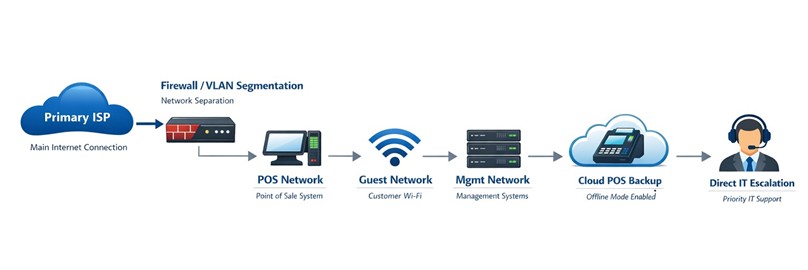
Opening-Day Redundancy Architecture
| Layer | Purpose |
|---|---|
| Primary ISP | Main internet connection for POS and operations |
| Firewall + VLAN Segmentation | Separates POS, guest WiFi, and management traffic |
| Network Isolation | POS, guest, and management networks operate independently |
| LTE Failover | Automatic cellular backup if primary internet fails |
| Cloud POS Offline Mode | Transactions continue even during outages |
| Direct IT Escalation | Immediate support if systems fail |
The Real Cost of Getting This Wrong
Restaurants operate on thin margins, and early operational failures compound quickly.
The average restaurant generates $2,000 to $10,000+ per day depending on size and concept. A POS outage, network failure, or payment system crash during opening week can easily wipe out $10,000 to $50,000 in revenue in a matter of days.
Compliance issues carry their own cost. Businesses that process card payments must follow PCI DSS (Payment Card Industry Data Security Standard) requirements. When a breach or compliance failure occurs, monthly non-compliance fines typically range from $5,000 to $100,000.
The reputational impact can be even more lasting.
Early online reviews shape how a new location appears in search results and recommendation algorithms. Guests watching payment terminals fail or waiting twenty minutes for a manual workaround rarely stay quiet online.
The takeaway is simple.
The cost of building security into a restaurant opening is small compared to the financial and reputational impact of a single week of operational failure.
Explore SpecGravity’s restaurant launch support services.
What Brands Planning Multi-Unit Openings Need to Know
For a single-location operator, one failed opening hurts. For a multi-unit brand or franchise system, the damage multiplies. Brand standards exist for food and service. They need to exist for technology, too.
A centralized configuration management approach means each new location is provisioned from a validated template, not built from scratch by a local vendor who may not know your integration stack. Opening checklists need to be standardized across the system, with sign-off required before a location goes live.
SpecGravity supports multi-unit restaurant brands with structured rollout programs designed for secure launches. See how our approach works across complex, multi-location deployments.
Conclusion
When a restaurant launch goes south, it usually happens because the technology was treated like a finishing touch. The most common restaurant opening technology failures are the result of assuming a system is ready just because it’s plugged in.
The reality is that these restaurant launch technology risks are entirely preventable. Success comes from a structured process.
The brands that get this right open on time, process payments cleanly, stay PCI-compliant from day one, and protect the revenue opportunity that a new location represents.
Book a launch planning consultation with SpecGravity before your next opening date is set.
Restaurant Opening Tech FAQ
What are the most common tech failures when opening a restaurant?
The biggest restaurant opening technology failures are usually POS glitches, payment errors, and messy WiFi. These typically happen when the tech setup is rushed during the final weeks of construction. If your delivery apps don’t sync or your guest WiFi isn’t separated from your business data, you risk a total restaurant IT failure on day one.
How can I prevent POS system failures at launch?
To avoid restaurant POS setup mistakes, run live transaction tests at least 30 days before opening. Process real cards, test split checks, and run refunds. Always have a spare, pre-configured terminal ready to go before your first guest arrives.
Why do restaurant payment systems crash during opening week?
A restaurant payment system failure is usually caused by an inactive merchant account or a firewall blocking the signal. If your network gets crowded, payment data can time out if it isn’t prioritized. This creates massive delays and serious restaurant opening security risks if your network isn’t segmented correctly.
What tech should be tested before a restaurant opening?
Follow a strict restaurant opening IT checklist. Test live POS sales, gift cards, and online ordering from start to finish. Ensure delivery apps route orders to the correct kitchen screens and that your inventory syncs. Finally, pull the plug on your main internet to see if your backup LTE kicks in.
What backup systems are necessary on opening day?
You need an LTE internet failover and offline mode enabled on all terminals. Keep at least one spare terminal on-site and ensure you have a direct line to a technical expert. Relying on a standard help desk queue is a major restaurant launch technology risk during a grand opening.
Which systems must be integrated before opening?
Your POS must be fully linked to your payment processor, delivery apps, and loyalty programs. Never trust the “out of the box” settings. Testing these restaurant POS integration issues with real transactions during your soft opening is the only way to guarantee they work.